 Learn Japanese Learn Japanese
A Beginner’s Guide to Japanese Prefixes and Their Meanings
In linguistics, a prefix is a word part attached to the beginning of another word to modify its meaning. In this post, we’ll explore 1 type of Japanese prefixes, that is honorific prefixes 御 (お〜, ご〜) and their meanings, focusing on modern usage while also mentioning some older uses of them.
Honorific prefix or polite prefixes お (o-) and ご (go-) attach to nouns (and some verbs and adjectives) to show respect or politeness. Both お- and ご- mean essentially “honorable” and don’t change the core meaning of the word. You would generally use these when referring to others’ things or in polite speech (e.g., お車 o-kuruma, “(your) car” vs. just kuruma for “car”).
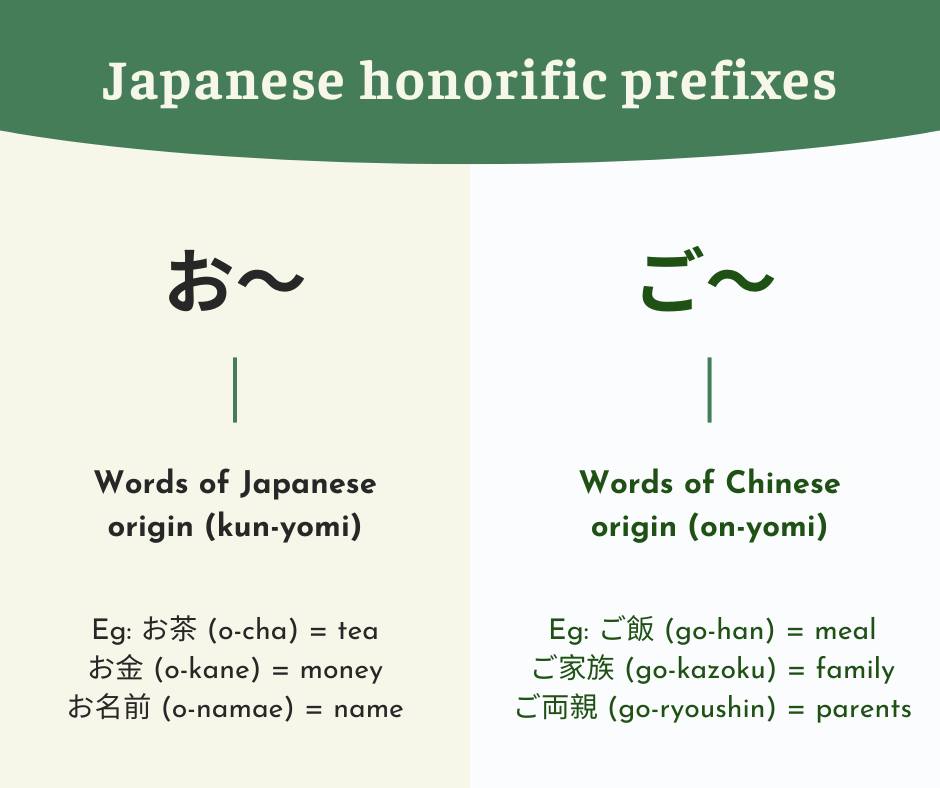
1. お〜
→ Used with words of Japanese origin (kun-yomi readings).
→ This Japanese “o” prefix adds a touch of respect or formality.
For example:
茶 (cha, tea) becomes お茶 (o-cha) to politely say “tea,” and 水 (mizu, water) becomes お水 (o-mizu, “water” in a polite way).
Many everyday terms take o- : お金 (o-kane, money), お名前 (o-namae, name), お寿司 (o-sushi, sushi).
2. ご〜
→ Used with words of Chinese origin (on-yomi readings).
→ The prefix ご is the same honorific 御 character, just with a different reading appropriate for Sino-Japanese vocabulary.
For instance:
飯 (meshi, rice/meal in kun-yomi) has the Chinese reading ‘han’, so to say “meal” politely, Japanese uses ご飯 (go-han).
Similarly, 家族 (kazoku, family) can be ご家族 (go-kazoku, your family (honorific)).
To remember using honorific prefixes, you should remember the vocabulary together with its prefix right when you learn it for the first time. Practice using it in real life such as writing Japanese paragraphs, speaking as much as possible so that you can be “familiar” with them.
Conclusion:
Understanding Japanese prefixes is like having a key that unlocks the meanings of many words. For beginners, start by noticing prefixes in words you already know – for example, the お in お金 (o-kane) or お箸 (o-hashi), or the ご in ご飯 (go-han). Recognize that the “go prefix” in Japanese indicates politeness with certain nouns, and that the “o prefix” does similarly for native terms. As you advance, you’ll spot prefixes like shin- for “new” or han- for “anti-” cropping up in newspaper headlines and product names and even guess unfamiliar words.
Related Post:
Basic Verb Conjugation in Japanese
10 Japanese Words for Learning about Japanese Culture