 Learn Japanese Learn Japanese
40 Essential JLPT N3 Grammar Points

I. Expressing process and result
1. ~始める(はじめる): To start doing something
How to use: V-stem + 始める
For example:
雨が降り始めた。
( あめがふりはじめた。)
It started to rain.
2. ~続ける(つづける): To continue doing something
How to use: V-stem + 続ける
For example:
3時間話し続けた。
( さんじかんはなしつづけた。)
I kept talking for 3 hours.
3. ~終わる(おわる): To finish doing something
How to use: V-stem + 終わる
For example:
レポートを書き終わった。
( レポートをかきおわった。)
I finished writing the report.
4. ~かける/~かけの : To be in the middle of doing; left unfinished
How to use: V-stem + かける/かけの
For example:
読みかけの本。
( よみかけのほん。)
A book I’m halfway through reading.
5. ~出す(だす): To suddenly start doing something
How to use: V-stem + 出す
For example:
急に泣き出した。
( きゅうになきだした。)
(He/She) suddenly burst into tears.
6. ~直す(なおす): To redo, to do again
How to use: V-stem + 直す
For example:
書き直す。
( かきなおす。)
To rewrite.
7. ~忘れる(わすれる): To forget to do something
How to use: V-stem + 忘れる
For example:
メールを送り忘れた。
( メールをおくりわすれた。)
I forgot to send the email.
8. ~切る(きる): To do something completely, to the end
How to use: V-stem + 切る
For example:
全部食べ切った。
( ぜんぶたべきった。)
I ate it all.
9. ~切れない(きれない): Unable to do something completely
How to use: V-stem + 切れない
For example:
一人では食べ切れない。
( ひとりではたべきれない。)
I can’t finish eating it all by myself.
10. ~込む(こむ) : To do something deeply, thoroughly, or to a certain extent
How to use: V-stem + 込む
For example:
考え込む。
( かんがえこむ。)
To be lost in thought.
II. State and manner of action
11. ~てしまう : To finish completely; to do something by accident or with regret
For example:
財布を忘れてしまった。
( さいふをわすれてしまった。)
Oh no, I forgot my wallet.
12. ~ておく : To do something in advance as preparation
For example:
ホテルを予約しておく。
( ホテルをよやくしておく。)
I’ll book the hotel in advance.
13. ~てみる : To try doing something
For example:
日本料理を食べてみる。
( にほんりょうりをたべてみる。)
I’ll try eating Japanese food.
14. ~ていく : A change that continues from now onward; to take something along
For example:
人口が減っていく。
( じんこうがへっていく。)
The population will keep decreasing.
15. ~てくる : A change that has occurred up to the present; to go and come back
For example:
日本語が分かってきた。
( にほんごがわかってきた。)
I’ve gradually come to understand Japanese.
16. ~てある : A state resulting from someone having done something in advance
For example:
壁に予定が貼ってある。
( かべによていがはってある。)
The schedule is posted on the wall.
17. ~っぱなし : To leave something as it is, without dealing with it
How to use: V-stem + っぱなし
For example:
電気をつけっぱなしにした。
( でんきをつけっぱなしにした。)
I left the light on the whole time.
18. ~たまま : To keep something in the same state
For example:
靴を履いたまま入った。
( くつをはいたままはいった。)
I went in with my shoes on.
III. Easily confused grammar patterns
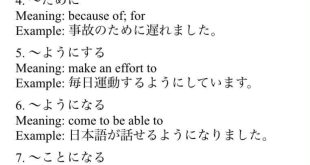
19. ~ようにする : To make an effort to do something regularly; to make it a habit
For example:
毎日運動するようにしている。
( まいにちうんどうするようにしている。)
I try to exercise every day.
20. ~ようになる : To become able to do something; to gradually change
For example:
漢字が読めるようになった。
( かんじがよめるようになった。)
I’ve become able to read kanji.
21. ~ことにする : To decide to do something (one’s own decision)
For example:
日本語を勉強することにした。
(にほんごをべんきょうすることにした。)
I decided to study Japanese.
22. ~ことになる : It has been decided that…; it turns out that…
For example:
来月転勤することになった。
( らいげつてんきんすることになった。)
It has been decided that I’ll be transferred next month.
23. ~ことになっている : It is a rule that…; it is scheduled or planned that…
For example:
ここでは靴を脱ぐことになっている。
( ここではくつをぬぐことになっている。)
The rule here is that you take off your shoes.
24. ~たばかり : Just did something
For example:
ご飯を食べたばかりだ。
( ごはんをたべたばかりだ。)
I just ate.
25. ~ところだ : About to do, in the middle of doing, or just finished doing
How to use:
Vる+ところだ: About to do
Vている+ところだ: In the middle of doing
Vた+ところだ: Just finished doing
For example:
今から出かけるところだ。
( いまからでかけるところだ。)
I’m about to head out now.
26. ~最中に (さいちゅうに) : Right in the middle of doing something
For example:
会議の最中に電話が鳴った。
( かいぎのさいちゅうにでんわがなった。)
The phone rang right in the middle of the meeting.
27. ~間 (あいだ) : During a period of time (throughout)
For example:
日本にいる間、日本語を勉強した。
( にほんにいるあいだ、にほんごをべんきょうした。)
I studied Japanese while I was in Japan.
28. ~間に (あいだに) : During a period of time, something happens or gets done
For example:
留守の間に荷物が届いた。
( るすのあいだににもつがとどいた。)
A package was delivered while I was out.
29. ~うちに : While still…; taking advantage before the situation changes
For example:
若いうちにいろいろ経験したい。
( わかいうちにいろいろけいけんしたい。)
I want to experience many things while I’m still young.
30. ~たとたん(に) : The moment something is done, something else happens
For example:
家を出たとたん、雨が降り出した。
( いえをでたとたん、あめがふりだした。)
The moment I left the house, it started to rain.
IV. Patterns common in reading comprehension
31. ~たびに : Every time…, … each time
For example:
この写真を見るたびに、旅行を思い出す。
( このしゃしんをみるたびに、りょこうをおもいだす。)
Every time I look at this photo, I remember the trip.
32. ~につれて : As… changes (together with a change in…)
For example:
年を取るにつれて、体力が落ちてきた。
( としをとるにつれて、たいりょくがおちてきた。)
As I get older, my stamina has declined.
33. ~にしたがって : In line with a change in…; in accordance with…
For example:
時間がたつにしたがって、痛みが消えた。
( じかんがたつにしたがって、いたみがきえた。)
As time passed, the pain gradually disappeared.
34. ~一方だ (いっぽうだ) : Keeps getting more and more…; continues in one direction
For example:
物価は上がる一方だ。
( ぶっかはあがるいっぽうだ。)
Prices just keep rising.
35. ~ば~ほど : The more… the more…
For example:
練習すればするほど、上手になる。
( れんしゅうすればするほど、じょうずになる。)
The more you practice, the better you get.
36. ~わけではない : It doesn’t necessarily mean…; it’s not that…
For example:
日本語が嫌いなわけではない。
( にほんごがきらいなわけではない。)
It’s not that I dislike Japanese.
37. ~わけがない : There’s no way that…; it can’t be that…
For example:
彼がそんなことをするわけがない。
( かれがそんなことをするわけがない。)
There’s no way he would do something like that.
38. ~はずがない : Certainly can’t be…; there’s no reason to think…
For example:
彼が知らないはずがない。
( かれがしらないはずがない。)
There’s no way he doesn’t know.
39. ~おかげで : Thanks to…; because of… (positive result)
For example:
先生のおかげで、合格できた。
( せんせいのおかげで、ごうかくできた。)
Thanks to my teacher, I was able to pass.
40. ~せいで : Because of…; due to… (negative result)
For example:
雨のせいで、試合が中止になった。
( あめのせいで、しあいがちゅうしになった。)
Because of the rain, the match was cancelled.
Related Post:
80 Important JLPT N3 Grammar Patterns
Learn JLPT N3 Grammar Flashcards: Part 1